Lately we've been learning about symmetry. Check out some of our work using symmetry:
Wednesday, November 26, 2014
Talking About Books, Connecting Across Texts
One of our goals as readers is to talk about books. We're lucky to have different books revolving around a particular concept or theme. Each child reads a book that is just right for him or her. Then we get into small groups with students who have read a different book on the same topic or theme. Students talk about each of their books and discuss a main idea or question. We call it Talking About Books, Connecting Across Texts, or TABby CAT time. Our 5th grade buddies were a lot of help getting us established with talking about books. Check it out:
We do such a nice job of taking turns, listening to what a friend has to say, and responding to all of the texts. TABby CAT is a fun time!
Monday, November 17, 2014
Learning About Cause and Effect
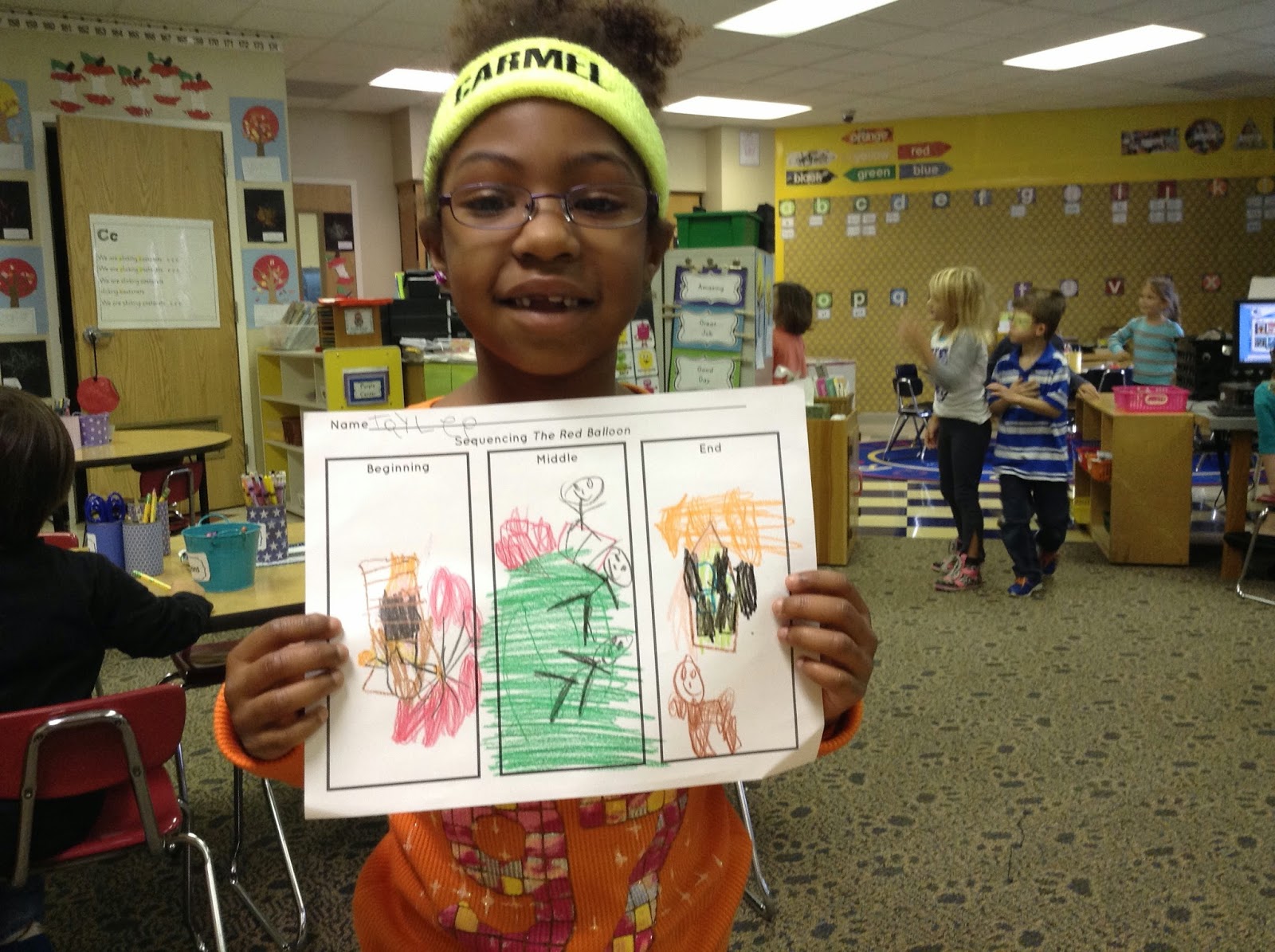
Retelling a story in sequence is a good way for us to learn about cause and effect. When we talk about events that occur in the book we're reading, we want to know why that event happened. What caused it?
One of the texts we read is Sofia and the Sunflower. While reading the story, we noticed a lot of similarities to the classic tale of Jack and the Beanstalk. One of the main events that happened in Sofia and the Sunflower was that it started to rain after a drought. What caused it to rain? What happened because it rained? Check out our thinking below:
Ask your child why it started to rain when the giant fell down. Ask your child what happened, or what was the effect, after the plants started to grow? Ask your child to retell the story of Sofia and the Sunflower.
We read other books to talk about cause and effect, too. One of our favorites was Pete the Cat: I Love My White Shoes. After retelling the story, we made another chart to help us understand cause and effect:
Using real-world examples to teach cause and effect is great, too! With your child, talk about what effect would happen if teeth weren't brushed? What might happen if vegetables weren't eaten? What effect would there be if no one cleaned up? What would cause someone to get a time out at home? Things to think about!
Since Sofia and the Sunflower reminded us of Jack and the Beanstalk, we spent time reading that story, too. Check out our comparison thinking map for the two stories below. (J stands for Jack and S stands for Sofia).
Sequencing a Story
One of the ways we're learning how to be better readers to to think about how the story goes. When we retell, we want to think about what happened at the beginning, the middle, and the end of the story. Sometimes we draw pictures to help us retell the beginning, middle, and end of a story.
Labels:
reading,
retelling,
sequencing a story
Using Everdaymathonline.com
Everdaymathonline.com is a free website for our students. The website contains games and parent information that goes along with what we've learned in class. You do need a user name and a password to access the site, however. Inside of your child's folder is your child's Everyday Math user name and password.
Once you get to everydaymathonline.com, the screen will prompt you to log in. Once you have logged in, the screen will look like this:
Of course, students will want to play the games, but there is other information there for you, too! Based on what we're learning in class, you can find family letters and do any time activities in the Home Connection section. In addition, you can check out some of the vocabulary words we'll be using in math.
You can change the top of the screen to other lessons to see new vocabulary words, family letters, or other do anytime activities.
To click on the games for students to play, click any game in the Games and Practice section of the website. It will look like this:
Your child should start to recognize the screen and know how to play some of these games already. There are one player games (against the computer) on the left and two-player games on the right.
As the year progresses, you and your child might find enjoyment playing new games. Check out the Challenge Games or the Grade 1 games.
Have fun using everydaymathonline.com!
Once you get to everydaymathonline.com, the screen will prompt you to log in. Once you have logged in, the screen will look like this:
You can change the top of the screen to other lessons to see new vocabulary words, family letters, or other do anytime activities.
To click on the games for students to play, click any game in the Games and Practice section of the website. It will look like this:
Your child should start to recognize the screen and know how to play some of these games already. There are one player games (against the computer) on the left and two-player games on the right.
As the year progresses, you and your child might find enjoyment playing new games. Check out the Challenge Games or the Grade 1 games.
Have fun using everydaymathonline.com!
Friday, November 7, 2014
Ask Your Child
We learned new vocabulary words this week: plant, pick, dig, put, and water. Ask your child if he or she can sequence planing a seed with these words. What do you have to do first? Plant a seed, dig a hole, or put water on the seed? What do you have to do next? Is it plant a seed, pick fruit from the tree, or put soil over the seed? After the seed is planted, what do you have to do? Is it water the seed, plant another seed, or pick the flowers? Can we pick a part of a plant before it is ready? What all do we need to put on the seed for it to grow? Ask your child!
Learning About Positional Words
Where is the best place to learn about positional words? On the playground! Over three sessions, we explored the meanings of several positional words on our playground. What fun!
Here we are at the start, or the beginning, of our journey
Do you see us at the top of the slide? We are above the slides. We are up high!
Here we come down the slide to the bottom.
The girls are on the top of the playset and the boys are at the bottom. The girls are above, and the boys are below.
Now we are below another playset.
The girls are on the swings.
The boys are going through the rings.
Here we are between the bike racks.
We are beside, or next to, the slide now.
The girls are on the left bench.
The boys are on the right bench.
Now we are in, or inside, the soccer goal! That was fun!
Now we are under a table.
Going around a pole is fun!
Step over the balance beam.
Here we are near the camera.
Now we are far.
Here we are going across a ramp. We're going up the ramp, too.
Slide around the pole to get down!
Phew! We are finished learned about positional words! That wore us out! Time to get off the playground and back inside.
Subscribe to:
Posts (Atom)