Image Map

Wednesday, January 14, 2015

Learning About Fiction

One of our literacy focuses this week was to learn about the characteristics of fiction.  First we read The Snowy Day by Ezra Jack Keats.
We learned that fiction stories have a character in a setting that does something.  Ask your child about who the main character in The Snowy Day is and where the story took place (the setting). Look at our thinking map for retelling what Peter did on his snowy day.
Next we read Sneezy the Snowman by Maureen Wright.  We loved this story!  It was so fun to read when the students could help me read it.
With Sneezy, we remember that stories have a character in a setting that does something, but we also learned that often fictional stories have problems.  Ask your child about what Sneezy's problem was. We learned that stories have solutions, too.  Sneezy tried lots of things to solve his problem. Ask your child which of Sneezy's attempts at solving his problem was his/her favorite.  Then ask them about which solution actually worked!

We talked about how stories have to have a beginning, middle, and an end with fiction, too.  Here is a quick picture of how we sequenced the Sneezy story.
Then we read Time to Sleep by Denise Fleming.
We continued our discussion on characteristics of fiction with this book, too.  We noticed that a lot of what was happening in the book sounded true like in non-fiction, but with the characters talking to each other, doing things, we realized that it is a fiction book, too.  Here is our thinking map for the characters in the story Time to Sleep.
The next time you and your child read a fiction text, think about who the characters are, where they are at, and what are they doing.  Is there a problem?  If so, how did the character solve it?  Encourage your child to retell the story from the beginning to the middle to the end.


Tuesday, January 13, 2015

All About Math Workshop

Have you ever wondered what my math class is like?  Here is a small peek into what we do most days in math.

First, we start off with calendar activities.  There is so much we do with the calendar that I think I'll save that for another post.  After the calendar activities, we do a whole group lesson.  We might learn a new concept, extend our learning from a previous lesson, or  learn how to play a new game.

Then we move into math in a small group, math with a partner, or math by myself.  I'm guessing that this is everyone's favorite part.  Every day students work on a learning target with a teacher in a small group.  The small group lesson might be an extension of the whole group lesson.  The lesson might be a review of a previously taught lesson, or it might be a new lesson that is better suited to small group learning.


In addition to working with a teacher in small group, students can either choose to work with a partner (math with a partner) or independently (math by myself).  Students then choose activities from a choice board to work on.  These activities help students explore and solidify math concepts.

Check out math workshop:


Friday, November 28, 2014

Learning Targets

Did you know that you can see what we learned and how we have learned it on our learning targets page?  At the bottom of the header of the blog there is a link called Learning Targets.

This page gives you information about our standards.  There are links to the Indiana Department of Education.  If you scroll down, you'll see links to what we have learned.  There might be a movie or two.  Check it out!  You'll also see what's coming up this year in your child's learning.

The Learning Targets page will updated throughout the year.  Don't forget to check it out from time to time!

Estimating with the Circumference of a Pumpkin

Not too long ago we learned about estimation.  We learned that to make an estimate, we make a good guess as to what the answer might be.
We wondered what the circumference of a pumpkin might be.  We each had a chance to unwind some yarn to a length we thought would fit exactly across the pumpkin.  Then we tallied our results.
I was so impressed with how close the estimates were.  We have spent time estimating objects in a jar and estimating time.
 

What else can we estimate?

Scenes Around the Classroom-November

Here's a peek of what our classroom looked like during the month of November:


Don't we look great?


Thursday, November 27, 2014

Writing Non-Fiction

We're putting our writing skills like finger spaces and sounding out words to good use:  we wrote a non-fiction piece!

After researching both bats and spiders, students could write about what they learned.

I asked for four facts about one topic.  That's four sentences!  We learned that sometimes writers have to take more than one day to write one piece.  I was impressed with how well students could share what they learned!

In the future, we'll have lessons on including a topic sentence and a conclusion.  We're on the right track!


Roll and Record

One of the favorite things to do in math class is play the game Roll and Record.  It's where we take a die, roll it, and record the roll on a bar graph.

First we tried it as a class on our class projector:

 Then we tried it on our own:


 We worked on Roll and Record with a partner, too:


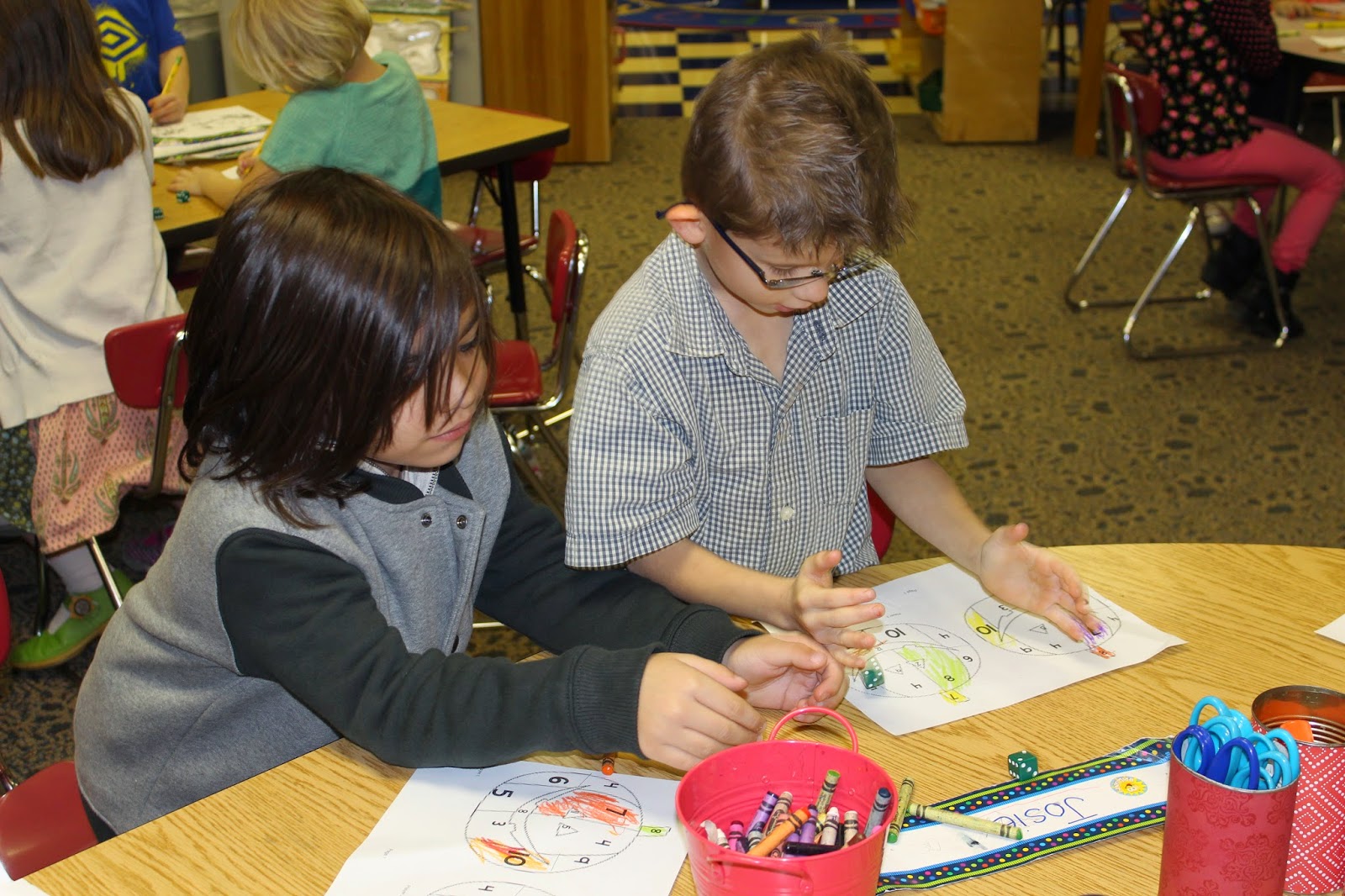
Partners would roll the dice, add up the two numbers, and color in a portion of a pumpkin on their recording sheet.  Roll and Record allows us to practice one-to-one correspondence, recording data, and interpreting results.  Even with all of that learning, students are still having fun!